
Council is proposing a Special Rate Variation (SRV) to apply exclusively to the mining rate category, safeguarding the Shire’s future and ensuring residents don’t bear the cost of mine closures.
Coal mining and power generation are at the heart of our community, and both Council and the wider community continue to support these industries through future challenges.
The Shire’s economy is changing. Coal mining is declining, and our largest mine and employer will close in 2030, with no mine approvals proposed after 2048.
Council has a track record of strong and responsible financial management, including an outstanding rating in the most recent Your Council report, particularly in the Own Source Revenue indicator of financial health.
It is Council’s responsibility to plan for the long-term financial sustainability of the Shire. The SRV will help maintain vital infrastructure and services while keeping residential, farming, and commercial rates among the lowest in the Hunter.
Why an SRV is needed
- Over half of Council’s rate revenue (56%) comes from mining.
- Mining rate revenue is projected to decline significantly as mines move toward closure.
- Council expects to lose $5 million a year in mining rates, with the gap widening to $18 million in 2044–45.
- Council needs to offset declining rate income to continue to deliver services to the community.
- Council does not want residents to bear the cost of mine closures.
What Council is proposing
Council is proposing a permanent increase to the total permissible rates of 29% through an SRV.
- The SRV will only be applied to the mining rate category.
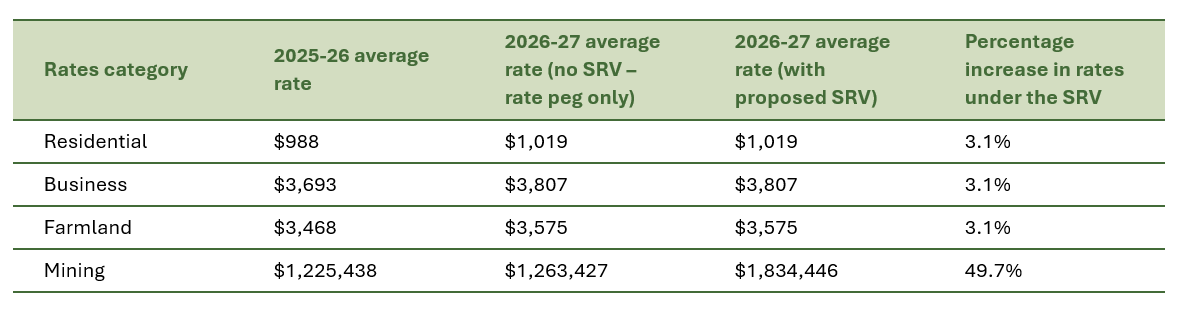
- The total 29% increase represents the rate peg set by IPART of 3.1% and the proposed SRV of 25.9%.
- The application of the SRV and rate peg will mean the mining rate category will contribute approximately an additional $6 million to Muswellbrook Shire in 2026/27.
Residential and other rate categories will adjust in 2026/27 to the standard rate peg set by IPART of 3.1%. The SRV does not apply to residential or other rate categories. Council is working to keep rates low for residential and other rate categories because we want Muswellbrook Shire to be a desirable place to live.
Council has decided to consider an SRV to address the decline in revenue now, while the mines are still operating.
Impact on average rates
How the SRV will be used
The proposed mining rate increase will be invested towards:
- Making Council more efficient, cost effective and customer focused
- Activities to bring new industry, jobs and investment to the Shire
- Council’s existing Future Fund to support a reliable income stream to offset the loss of mining rate revenue
Introducing an SRV now, while mining companies still operate, is a responsible measure to avoid higher rates for residents and businesses as the mines move towards closure.
FAQs
TopCouncil is responsible for planning for the long-term financial sustainability of the Shire.
Council currently raises more than half (approximately 56%) of its rate income from mining rates. This rate revenue is projected to significantly decrease as mines move towards closure. As a result of these closures, Council expects to have $5 million less in mining rates per year, with the mining rates revenue gap widening to $18 million by 2044-45.
At the same time, the cost of delivering essential services – roads, waste, parks, libraries, community facilities – continues to rise.
Council is applying for a Special Rate Variation (SRV) to maintain vital infrastructure and services for the community into the future, and to limit the impact of mine closures on residents and the community.
Council is proposing a permanent increase to the total permissible rates of 29% through an SRV. The SRV will only be applied to the mining rate category and the total increase of 29% is made up of the rate peg set by IPART of 3.1% and the proposed SRV of 25.9%.
Residential and other rate categories will not be impacted by the SRV.
IPART sets the annual rate peg for Councils, which is the maximum amount that a Council is permitted to raise rates.
Muswellbrook’s rate peg is 3.1% in 2026/27, which will be applied to residential and other rate categories as in previous years. The rate peg of 3.1% is the lowest in the Hunter.
The SRV increase will apply to the mining rate category only. There are currently 11 parcels of land in the mining rate category.
As mines move towards closure, the rate revenue collected from mines will also decline. Council currently raises approximately 56% of its rates income from mining, which is $13.2M in 2025/26.
As a result of these closures, Council expects to experience a reduction of $5 million in mining rates from 2031, with the mining rates revenue gap continuing to widen to $18 million by 2044-45.
The mines have the capacity to contribute more now, while they are in operation, to reduce the burden on residents and other ratepayers to cover the projected shortfall.
The closure of a mine is ultimately a decision for each individual mining company and Council has no control or influence over this decision.
Without early action, rising costs and reduced rate revenue will create a growing gap between Council resources and the services our residents rely on.
If Council were not successful in seeking the proposed SRV, there is expected to be several impacts over the next 20 years, including:
- As mining rates reduce, the burden of rates would need to shift to other ratepayers. Council would likely need to consider another SRV to fund the loss of rates revenue in future years. However, this would need to be levied on all ratepayers, including residential, business, and farmland.
- Without the proposed SRV funding investment in economic development, Council would find it difficult to attract new industry, businesses and visitors to the Shire.
- Without new industries and businesses to offset the jobs and spending currently provided by mining, it is likely that the local economy will suffer, and people may need to move away from the area for employment.
- The longer-term impacts of not acting now, while coal mining is still in the region and able to contribute, could lead to a longer-term spiral of financial and economic uncertainty that would be increasingly difficult and costly to recover from.
Council has a track record of strong and responsible financial management.
Council’s 2025/26 audited financial statements confirm:
- Net operating surplus before capital grant contributions: $6 million
- Cash reserves: sufficient to cover 12 months of operating costs
- Key financial ratios:
- Unrestricted cash current ratio of 2.04 against a state benchmark of 1.5
- Infrastructure renewals 75%, up from 61%
- High operating performance ratio of 9.9%
Council is not reacting to a crisis. We are planning ahead to protect the Shire from a period of uncertainty and economic transition.
Council has implemented several actions to reduce costs and plan for the future including:
- The establishment of the Future Fund to generate an additional long term revenue stream
- Building of internally allocated cash reserves to ensure renewal and replacement of assets, and contingency
- A program of continual improvement including making changes to Council’s procurement practices, consolidating vacant positions, and improved asset management to reduce downtime
- Deployment of new software, cyber security measures and IT purchasing practices
- Bringing new industry and investment to the Shire including the Post Mining and Beneficial Land Use Pilot Project
Funds from the proposed SRV will be invested in:
- Productivity improvements – to optimise Council’s operations and be more customer focused to align with community expectation. This will include:
- Improving how we manage our assets including roads, equipment, plant, parks and buildings and their maintenance;
- Digital improvements which respond to advancements in technology, legislative requirements and customer needs to improve how we do business; and
- Investment in energy efficient infrastructure to save on power costs.
- Economic activities – to bring new industry, jobs, and investment to the Shire.Investment in economic activities will support economic diversification, grow revenue, and reduce the impact on businesses and the community as our economy changes, including:
- Working with industry and government to unlock land to secure new industry opportunities;
- Re-position and promote the Shire globally as a great place to do business; and
- Deliver events and initiatives which make Muswellbrook Shire a great place to live, attract visitors, and support business.
- Future Fund – to offset the loss of mining rate revenue.
- Further investing in Council’s existing Future Fund will provide a reliable long term income stream to reduce the gap from the loss of mining rates revenue.
Over the last 15 years, Council has established and grown a Future Fund, which is largely a property investment portfolio. The Future Fund helps generate additional revenue to address the gap in revenue that will be caused by the decline of mining rates.
However, the level of the current investment is not sufficient to fully cover the revenue gap that will be created.
In the 2026/2027 financial year the SRV will raise approximately $6m.
The NSW rate-peg is set by IPART and is an annual cap on how much councils can increase general rates.
Residential and other rate categories will only see the rate-peg increase, which is 3.1% for 2026/27.
Rate pegging caps the overall amount of income, not individual rates. Your individual rates may go up or down depending on your land value, but Council’s total rate revenue must stay within the capped increase.
- Complete the SRV survey
- Talk to Council staff at a drop in session
- At the TEC 1 Building ground floor, 87 Hill Street, Muswellbrook
Thursday 11 December 2025 10am to 11am
Saturday 13 December 2025 2pm to 3pm
Tuesday 16 December 2025 3pm to 4pm - At Denman Memorial Hall, 30 Ogilvie Street, Denman
Wednesday 17 December 2025 10am to 11am - At Campbells Corner, 60-82 Bridge Street, Muswellbrook
Thursday 18 December 2025 10am to 11am - At Muswellbrook Marketplace
Thursday 18 December 2025 3pm to 4pm
- At the TEC 1 Building ground floor, 87 Hill Street, Muswellbrook
- Make a submission to the Long Term Financial Plan on public exhibition
- Send us an email at enquiry@muswellbrook.nsw.gov.au
The final decision is made by the Independent Pricing and Regulatory Tribunal (IPART). IPART is the independent pricing regulator for water, energy, public transport, and Local Government. They set the allowable rate cap and approve any Special Rate variations.
IPART will either approve or not approve this SRV application.
Council must demonstrate all of the following:
- a clear need for the increase
- long-term financial sustainability
- community support or understanding
- transparent modelling and engagement
Once the community consultation period concludes on 7 January 2026, Council will review the feedback received. A report will then be submitted to Council for its consideration in January 2026. Council will then finalise and submit its application to IPART.
The application must be submitted to IPART by 2 February 2026. IPART will conduct its own consultation, with public submissions likely to be sought in March 2026, before IPART makes its determination in May 2026. If successful, the SRV will be included in rates from 1 July 2026.
The SRV is one element of Council’s broader strategy to:
- manage mining decline;
- attract new industries and create population growth;
- maintain liveability and infrastructure; and
- preserve our low residential rates.
It ensures Muswellbrook Shire remains strong, competitive, and well-serviced during the wider economic uncertainty.
Send us an email at enquiry@muswellbrook.nsw.gov.au and we’ll respond to you.